Products | Threadbird
Products
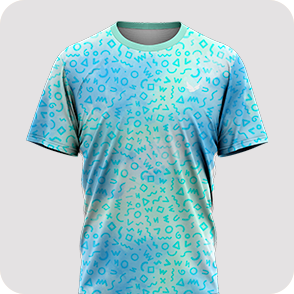
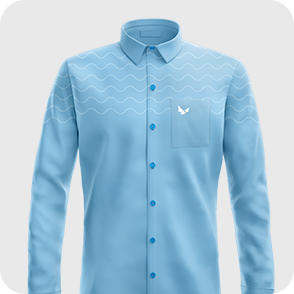
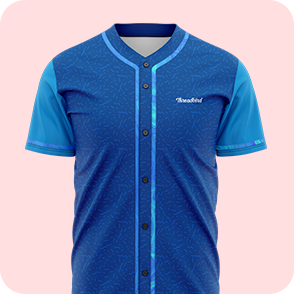
At Threadbird we specialize in custom merchandise, which means we have it all... from Apparel to Screen Printed Posters to Custom Plush Toys.
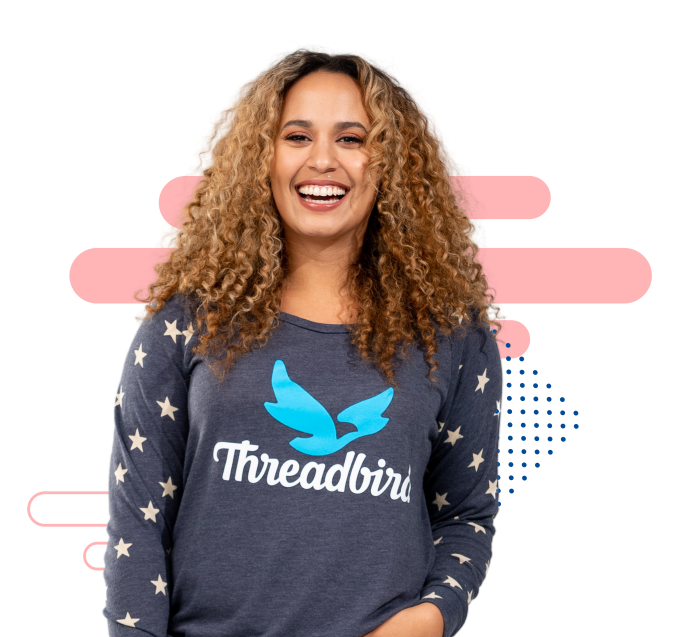
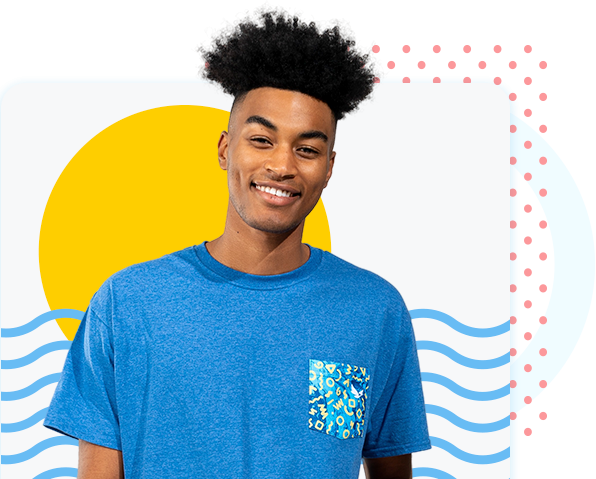
Apparel Products
Lorem ipsum dolor sit amet, consectetur adipiscing elit, sed do eiusmod tempor incididunt ut labore et dolore magna aliqua.
Production time 3-4 weeks
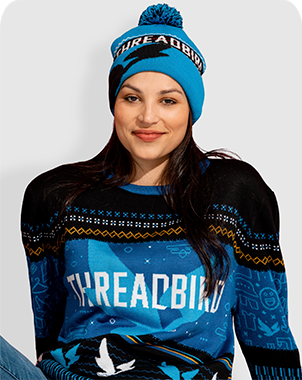
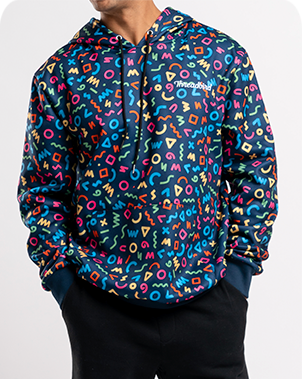
Paper Products
Lorem ipsum dolor sit amet, consectetur adipiscing elit, sed do eiusmod tempor incididunt ut labore et dolore magna aliqua. Ut enim ad minim veniam, quis nostrud exercitation ullamco laboris nisi ut aliquip ex ea commodo consequat.
This Flex Card Section is nested inside a Full Container,
which allows us to use the Blue Wave Background.





Scale Your Clothing Brand: The Ultimate Guide to Custom Apparel Printing and Production
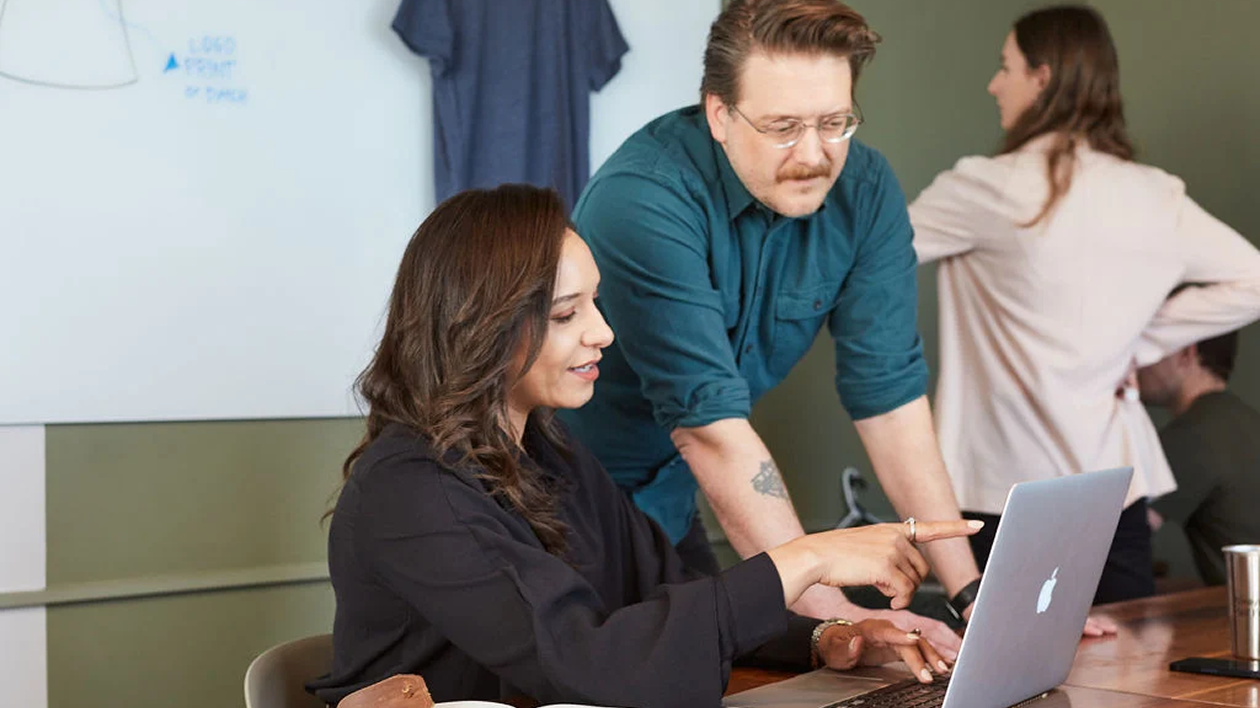
You’ve got the look, the drive, and the vision. But if you’ve tried to scale on hustle alone, you’ve probably hit a wall.
Most brands end up stalled in this weird middle zone—too big to keep winging it, not quite big enough to have a whole team. And that’s when stuff starts breaking. Fans are buying. Drops are selling out. But behind the scenes?… Delays. Inconsistencies. Inbox chaos. Plus, that recurring frustration that you’re always putting out fires instead of building what’s next.
We get it. We’ve helped hundreds of brands navigate this phase, and the shift almost always begins with better custom apparel printing and production. This isn’t just about finding a better printer. It’s about building a real system that lets you grow without falling apart in the process.
Scaling your brand means leaving behind the scrappy tactics that got you started and embracing systems that grow with you. Let’s start with the foundation: how your production process either powers your momentum or silently stalls it.
Ready for the next step? Jump ahead and download our toolkit: How to Grow Your Clothing Brand
What Today’s Mid-Sized Clothing Brands Must Get Right About Production
In the early days, things are scrappy—but they work. You’re printing in small batches. Orders are packed in your apartment or garage. You’re improvising, solving problems in real time, and riding the energy of momentum.
But as your brand grows, things get more complex. And the friction shows up fast:
- Quality starts to dip
- Shipments get backed up
- Inventory becomes unpredictable
- You’re spending more time managing and less time creating
If your production setup isn’t built to scale, it will eventually hold you back.
This isn’t just about getting more product out the door. It’s about building a production and fulfillment process that’s efficient, reliable, and aligned with your brand.
What actually works?
A smart, scalable production plan that balances:
- Quality: Consistent results that reflect your brand standards
- Speed: Reliable shipping and turnaround times
- Consistency: Fewer errors, fewer headaches
- Creative Freedom: Partners who understand your goals and bring your vision to life
When your production and fulfillment are dialed in, you gain time, clarity, and headspace to focus on what truly drives growth: your vision, creativity, and customer experience.
Once you’re ready to build a smarter production system, the next step is choosing the printing method that best aligns with your goals. This isn’t a technical detail—it’s a branding decision.
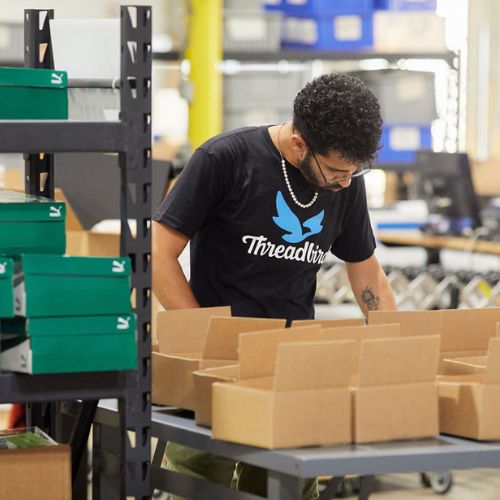
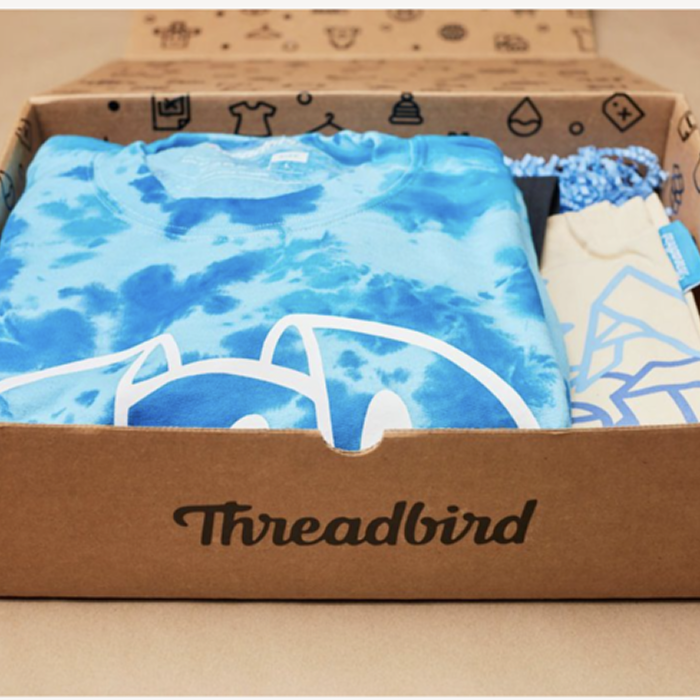
Picking the Right Printing Method
Choosing a printing method isn’t just about inks and machines—it’s about how your brand shows up in the world. Every decision here impacts how your merch feels, how it wears, and how well it aligns with your creative and business goals.
The method you choose can affect:
- Your margins: Some techniques may cost more upfront but scale more effectively in the long term.
- Your quality control: Certain methods offer tighter detail or more consistency.
- Your customer experience: The feel, durability, and finish of your product convey a lot about your brand.
Let’s compare the most common printing methods and explore what they mean for your brand. To find the best fit, consider your growth stage, typical order volume, and how much flexibility you need. Let’s break down the strengths of two key methods: Screen printing and direct-to-garment.
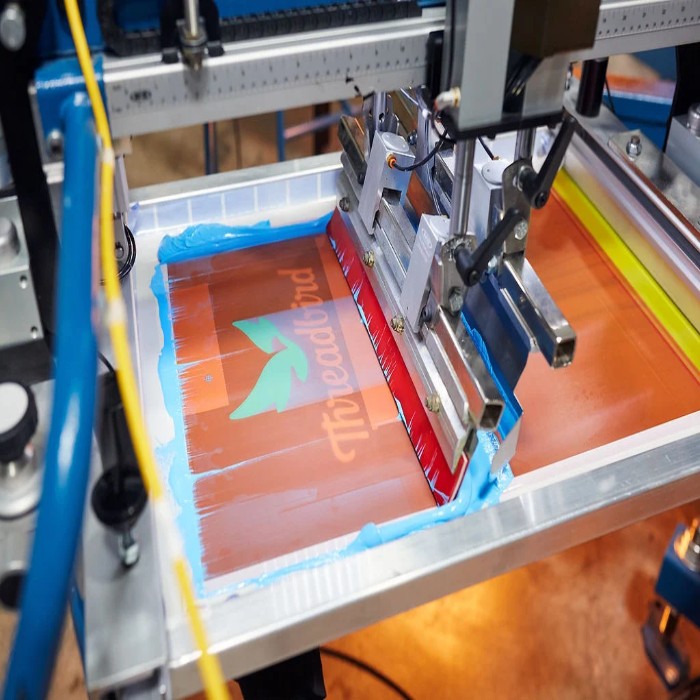
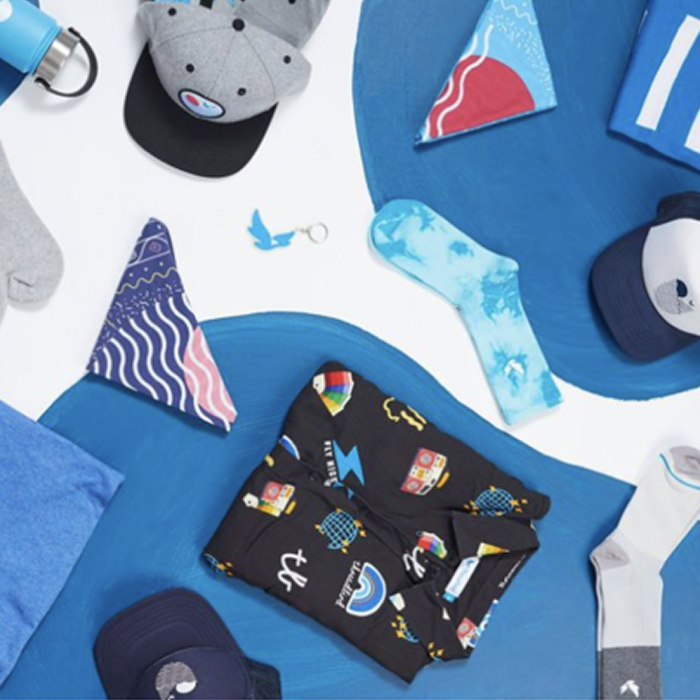
Screen Printing vs. DTG (Direct-to-Garment)
If you’re caught in that in-between zone—growing but still testing—this comparison matters.
- Screen printing is built for scale. Once you know a design will sell, this method keeps your costs down and your quality consistent.
Use screen printing when producing larger-sized batches, working with bold graphics, or when you want long-lasting color. It’s highly cost-effective at scale and delivers vibrant, durable prints. - DTG lets you stay nimble. Think: limited drops, niche designs, micro-inventory.
Use DTG for smaller runs, high-detail artwork, or quick-turn drops without large setup costs.
Of course, not all garments are created equal, and neither are your design needs. When you're looking for polish and texture over color coverage, embroidery comes into play.
Embroidery vs. Screen Printing
- Embroidery adds texture, dimension, and polish—perfect for hats, jackets, or premium pieces that convey a more elevated or structured feel.
- Screen printing is best suited for soft, flexible garments like tees and tanks, where comfort and full-color artwork matter more.
For brands with a bold creative edge, reproducing photorealistic art or gradient-heavy designs takes special care. Simulated process printing is your go-to when ordinary methods fall short.
Simulated Process Printing (for Photorealism)
Want to turn a photograph, painting, or gradient-rich design into apparel without it looking muddy or overworked?
The simulated process uses screen printing to layer inks in a way that mimics full-color images, without the blur or saturation issues that can occur with other methods.
Perfect for:
- Artistic merch lines
- High-end band or event tees
- Visual storytelling pieces
Want to learn more about photorealism printing? Dive into this great read: Unlocking Photorealistic Apparel: Simulated Process Screen Printing
The printing method isn’t the only choice that impacts quality—your ink selection is just as crucial. Let’s examine how ink types influence everything from feel to eco-friendliness.
The Ink Actually Matters
It’s easy to overlook ink types, but they directly affect the look, feel, and longevity of your product.
- Plastisol: Durable and vibrant, with a slight sheen. Great for traditional prints, but less breathable.
- Water-based: Soft, breathable, and more eco-friendly. Blends seamlessly into the fabric but may fade more quickly without proper care.
- Discharge: Removes dye from the fabric before applying new color—ideal for soft, vintage-style designs with a lived-in feel.
Choosing the correct ink is like choosing the right fabric—it shapes the whole customer experience. For a deep dive into the world of ink, check out our article, Exploring the Spectrum: Apparel Printing Ink Types
The Bottom Line?
There’s no “best” method—only the one that fits your current phase, your creative goals, and your growth strategy.
With your production and printing choices dialed in, it's time to turn our attention to the next critical link in the chain: fulfillment. Because smooth delivery isn't just operational—it’s a brand promise.
Why Fulfillment Is More Than Just Shipping Orders
We say this all the time because it’s true: Fulfillment is part of your brand.
From the second someone clicks “Buy” to the moment they open your package, every detail communicates something about who you are—your quality, your reliability, your values. That journey from cart to doorstep is more than logistics. It’s brand storytelling in real-time.
And when it goes wrong?
- Packages arrive late (and support emails pile up)
- Customer receives the wrong item(s) (and your credibility takes a hit)
- Packaging feels generic or careless (and the unboxing moment falls flat)
- First-time buyers don’t come back—and word spreads
But when it goes right?
- You earn trust—and buyers become repeat customers
- You reduce friction—so your team isn’t buried in fix-it mode
- You create a moment—that feels aligned with the brand they fell in love with
- You scale with confidence—because your back end isn’t holding you back
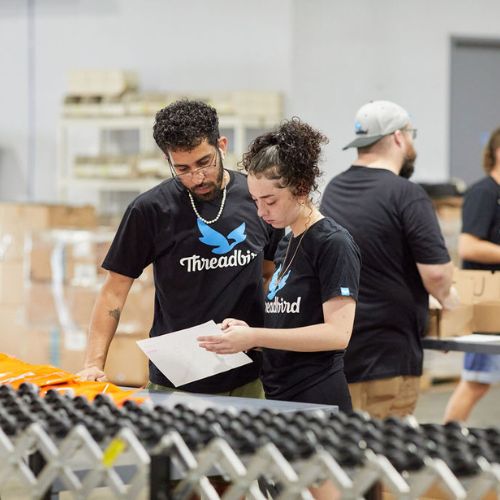
Professional fulfillment services integrate your custom printing, production, and shipping, all done efficiently and accurately while maintaining brand consistency. A great fulfillment solution delivers more than just a product—it helps you deliver on your promise.
No more duct-taping components together. No more scrambling to fix mistakes.
Just smooth processes, reliable delivery, and packaging that feels like it was made with your customer in mind—because it was.
There comes a point in every brand’s growth when “doing it all” starts doing more harm than good. If you’re feeling the strain, it’s a good indication that you should start exploring the benefits of outsourcing.
Custom Apparel Fulfillment: The Secret to Clothing Brand Success
When to Stop Doing It All Yourself (When’s the Right Time to Outsource)
There’s a time for scrappy. And then there’s a time to let go—before burnout starts doing the decision-making for you.
In the early days, doing everything yourself made sense. You’re close to your product. You’re learning fast. You’re building something from the ground up, and every detail matters.
But at a certain point, what got you here starts getting in your way.
Still taping boxes at midnight? Still answering fulfillment questions on launch day?
Still sprinting to keep up while strategy sits untouched?
Yeah… it’s probably time.
Signs you’re ready to outsource:
- You’re shipping 30+ orders a day—consistently
- Your launches are exciting but exhausting
- Your living room is doubling as your warehouse
- You spend more time fixing fulfillment errors than creating new products
- Customer support is creeping into your creative time
How to make the shift (without losing control):
- Start small: Test with a single product line or drop to get comfortable.
- Protect your brand: Keep your packaging, inserts, and unboxing experience at the forefront.
- Choose a fulfillment partner who gets it: You want someone who understands the pace and personality of fashion and lifestyle brands, not just logistics.
Outsourcing doesn’t mean giving up control—it means reclaiming your time so you can lead, design, and grow with less chaos and more clarity.
Handing off fulfillment is a big step, but choosing the right partner makes all the difference. Here’s how to find someone who gets your brand and helps you deliver it flawlessly.
What to Look for in a Fulfillment Partner
Not every fulfillment center is built for clothing brands.
Some are built for bulk. Others for books, tech, or high-SKU ecommerce. But apparel? That’s a different game. You’re dealing with sizes, colorways, seasonal drops, preorders, custom packaging, and a fast-moving audience that expects things to land just right.
You don’t just need a vendor.
You need a partner who understands the nuance of fashion logistics—and protects your brand with every order.
Here’s what to look for:
- SKU-Level Accuracy
A mix-up between black and charcoal—or small and medium—can tank a customer’s experience. Your partner should have rigorous systems in place to prevent errors, especially during peak volume. - Returns That Don’t Hurt the Brand
Returns happen. But they shouldn’t feel clunky or chaotic. Look for a partner with a returns workflow that’s fast, clean, and keeps the customer experience intact—from return label to resolution. - Drop-Friendly Flexibility
If your brand operates on a drop model or limited collections, you need a fulfillment system that can ramp up, scale down, and pivot quickly. Fixed-volume warehouses won’t cut it. - Custom Packaging Support
Unboxing is part of your brand story. Your fulfillment partner should be able to accommodate custom packaging and add-ons without making it a logistical nightmare. - Transparent Communication
When things get busy (and they will), you want a team that picks up the phone, answers emails, and partners with you in problem-solving—not one that disappears behind a ticketing system. - Fashion-Specific Insight
Bonus points if your partner already works with other apparel or lifestyle brands. Familiarity with garment SKUs, fabric handling, and seasonality can make a significant difference.
A great fulfillment partner helps you scale without losing touch with your customers or your creative edge.
With the backend sorted, it’s time to focus on what your customers see and feel. Great merch doesn’t just look good—it leaves a lasting impression. Here’s how to design for connection and repeat wear.
➡️ Download our toolkit: How to Grow Your Clothing Brand
Designing Merch That Stands Out and Sells Out
The best merch doesn’t just move units—it becomes someone’s favorite tee.
The one they wear on repeat. The one that gets compliments. The one they tag you in on Instagram.
Great merch gets loved, shared, and reordered—not just once, but repeatedly.
So what makes that happen?
Fabric That Actually Feels Good
It sounds obvious, but many brands choose blanks based solely on cost.
Comfort and quality matter—because if it doesn’t feel good, it doesn’t get worn. And if it doesn’t get worn, it doesn’t get remembered.
Choose materials that match your vibe:
- Lightweight for lifestyle brands
- Heavyweight for streetwear
- Sustainable for eco-conscious labels
You want customers to feel the difference—literally.
Design Placement That Flatters
Great artwork deserves great placement.
Print too low, and it looks off. Center it wrong, and it throws off the whole fit.
We’ve seen small changes—like moving a graphic up an inch—turn a “meh” shirt into a bestseller. Placement isn’t just technical; it’s visual storytelling.
Custom Labels and Finishes That Make It Yours
If your merchandise is great, but the tag says “Gildan,” you’re missing a huge branding opportunity.
Custom labels and finishing touches are where your merch stops feeling generic and starts feeling premium. These small details say, “This was made for you.” They reinforce your brand identity, elevate perceived value, and demonstrate to customers you care about every stitch.
A few finishing upgrades worth considering:
- Printed or woven neck labels to replace stock tags
- Hem tags or sleeve labels that add a subtle, stylish brand touch
- Hang tags with messaging, QR codes, or product details
- Fold-and-bag services that give your product a retail-ready feel
These elements don’t just enhance aesthetics—they enhance trust. They signal professionalism and intention, especially when you're scaling and want your merch to compete with top-tier retail brands.
And the best part? Once set up, these finishes can be part of your standard production workflow—making consistency easy drop after drop.
It’s one of the simplest ways to level up without overhauling your entire line.
Packaging That Feels Like an Experience
Unboxing isn’t an afterthought. It’s a moment.
The first tactile impression of your brand.
Whether it’s a sticker, a handwritten note, or tissue paper that matches your palette—those little details make your merch feel like a gift, not just a product.
Consistency That Scales
The hardest part of building great merch isn’t doing it once—it’s doing it again, at scale, without losing quality or control.
That’s where the right production partner makes all the difference.
Guess what? Threadbird helps with all of the above!
From color matching to sizing breakdowns, from label printing to final fold, we help you make merch that doesn’t just look good but also resonates with your customers.
Because when your merch hits all the right notes—comfort, fit, finish, and feel—it stops being a product and starts becoming part of your brand identity.
Read more about how to elevate your brand with great garments and great production:
➡️ 5 Ways to Create Great Merchandise That Elevates Your Brand
It’s important to note here that even the best merch won’t move if no one knows about it.
“But marketing is draining,” you think. It doesn’t have to be. Let’s discuss building a system that amplifies your brand while providing you with the breathing room to stay creative.
Build a Marketing Engine (That Doesn’t Burn You Out)
One great launch is exciting.
Ten in a row with no systems? That’s burnout city.
When you’re deep in the details of designing, producing, and fulfilling merch, marketing can easily become the thing you’re always scrambling to catch up on. But to grow sustainably, you need more than a one-off hustle—you need a repeatable, scalable system that works even when you're focused elsewhere.
Here’s how to build a marketing engine that keeps your brand in motion (without draining your creative energy):
Plan Drops + Content Together
Your launch calendar and your content calendar shouldn’t be separate.
Plan social posts, email campaigns, and influencer outreach in sync with your production schedule—so your audience is primed when it’s go time.
Bonus: This makes batching and scheduling content ahead of time way easier.
Automate the Essentials
You don’t need to write every email from scratch.
Set up automated flows for:
- New product launches
- Back-in-stock alerts
- Abandoned cart reminders
- Post-purchase follow-ups
And don’t sleep on SMS—short, timely messages can drive huge spikes in engagement and sales when used strategically.
Turn Buyers into a Community
The most successful merch brands don’t just sell—they connect.
When your customers feel like they’re part of the journey, they stick around—and spread the word, so encourage:
- UGC (user-generated content) through hashtags or customer spotlights
- Exclusive access for repeat buyers
- Feedback loops that make your audience feel heard
Leverage Influencers + Ambassadors
Even small creators can make a big impact if their audience aligns with your brand.
Send early access drops, co-create designs, or feature them in your content.
Just make sure it feels authentic—audiences can spot forced promos from a mile away.
Use Data to Refine, Not Just React
What worked? What didn’t? What content actually drove traffic or conversions?
Look at your numbers not just for answers, but for the patterns they reveal.
Your marketing engine should get smarter over time, not just busier.
You don’t need to market like a machine. You just need a system that supports your creativity, rather than overwhelming it.
Need proof that these strategies work? This case study follows one brand’s transformation from chaos to clarity—and shows what’s possible when you put the right systems in place.
Case Study: How One Brand Scaled with Threadbird
Walk In Love was a brand on the rise—with a loyal audience, high-demand drops, and big dreams. But behind the scenes, things were starting to strain.
They were juggling inventory headaches, a growing number of SKUs, and a fulfillment process that couldn’t keep pace with their growth—or their creativity. In addition, the founders had a bold vision: to relocate to Maui and build a business that supported both their lifestyle and their mission.
To make that leap, they needed more than hustle—they needed structure.
With Threadbird, they:
- Cleaned up their SKU system so every item was easy to manage, track, and reorder
- Streamlined their fulfillment to eliminate manual work and reduce errors
- Integrated printing + shipping so everything flowed from production to doorstep
- Freed up headspace to focus on what really mattered: storytelling, content, and building community
Now they’re running a brand that’s not only profitable—but peaceful.
They’re still creating meaningful products and sharing their journey, but without the daily chaos.
The takeaway?
Scaling doesn’t have to mean stress.
With the right systems and support, you can grow and stay true to who you are—whether you’re in Pennsylvania or paradise.
➡️ Read the full story: Walk With Love’s Big Move to Maui
Every step in your journey matters—from concept to customer. And with the right support, you can scale your brand with purpose, passion, and peace of mind.
From First Stitch to Final Ship — Threadbird Helps Your Brand Grow
You didn’t start this brand to chase shipping labels or manage inventory spreadsheets.
You started it to create. To connect. To build something that resonates—and lasts.
But as your brand grows, so does the operational weight.
Drops get bigger. SKUs multiply. Customers expect faster turnarounds and cleaner packaging. And suddenly, your time is spent managing logistics instead of designing your next big thing.
That’s where we come in.
At Threadbird, we help brands grow with:
- Expert custom apparel printing that brings your vision to life—whether it’s your first run or your fiftieth
- Branded packaging and finishing touches that make every order feel like an experience
- Reliable, fashion-focused fulfillment that runs behind the scenes, so your brand can stay front and center
We’ve worked with hundreds of creative brands through that tough middle stage—the part where you're too big to wing it, but not quite ready to build a warehouse team.
Whether you’re launching a new product line, testing microdrops, or prepping for your next big move (like Walk In Love’s cross-country scale-up to Maui), we’re built to grow with you.
Let’s take the chaos off your plate—so you can get back to doing what actually moves your brand forward: building, storytelling, designing, and leading.
Because, from the first stitch to the final ship, your vision deserves support that’s just as dialed in as you are.
➡️ Download our toolkit: How to Grow Your Clothing Brand
Showcase Your Stuff - Presenting your products

Presenting your Clothes
You’ve received your products, gathered your equipment, and you’re ready to start taking pictures. Now it’s time to decide how to present those products. Stand out images on social media can be the thing that sets you apart from your competition and brings in more customers to your webstore.
The way you display your items becomes a part of your brand identity, so you’ll want to consider how best to tell your brand’s story.
Flat Lays
Flat lays are an easy way to show off your items if your brand, especially if you’re just starting out. It’s a quick and easy way to display your items without the use of a model. Flat lays are exactly what they sound like - an item is laid out flat and an image is taken from above.


Flat lays typically incorporate some sort of theme, utilizing backgrounds and props to help the items in the image pop. If you want to learn more about how to arrange and take flat lays check out our guide on taking great flat lays.
Models
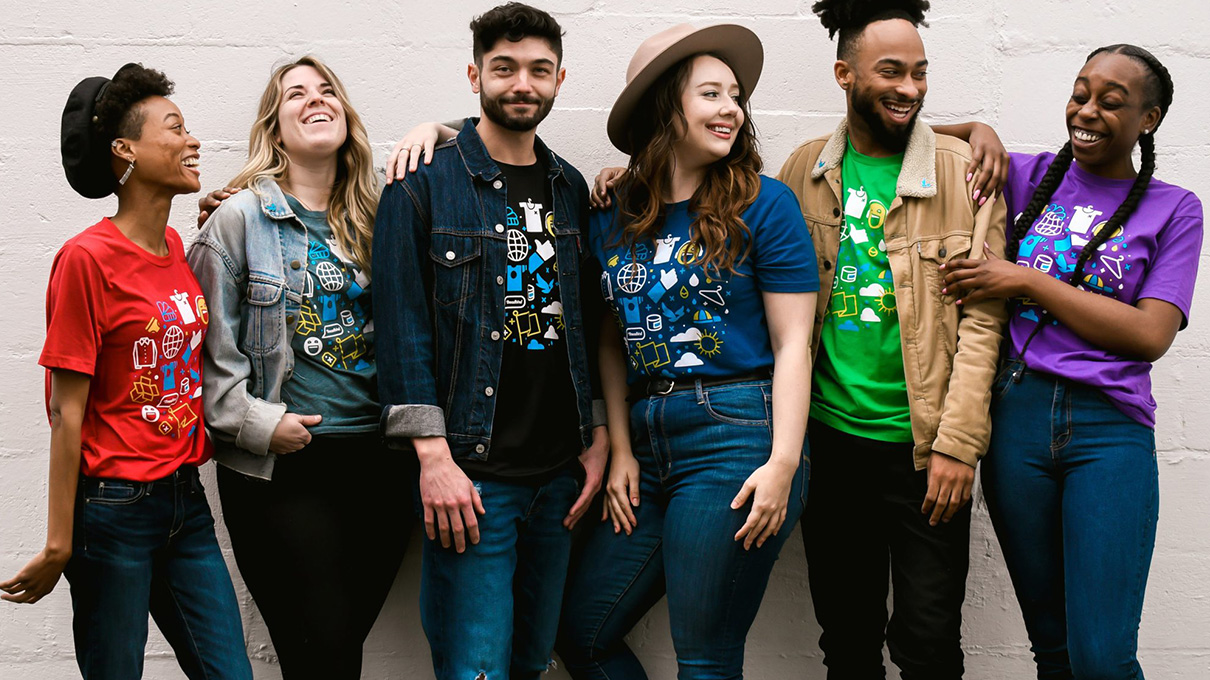
When it comes to showing off your products, using an actual person is one of the best ways to show how your item fits. Your model’s look and style can help to better define your brand and attract like-minded customers.


Choose models that your customers can relate to. Your models become a face to relate to for your brand - they help your customers see themselves in your garments.
But, how do you find models?
- Don’t be afraid to ask your friends or people you know. They might know your brand the best!
- Reach out to an agency. Your local modeling agency has a pool of talent waiting to get booked.
- Create a talent call and post it to your Instagram. Reach out to your customers to find fresh faces who love your brand.
- Use Brand Ambassadors! (We’ll get more into that in a moment)
Using models is a great way to bring your customers into the conversation and show off your products.
Brand Ambassadors
Brand ambassadors are people who already love your brand and want to see it grow. Having brand ambassadors allows you to create killer content with customers who are passionate about your products. These are people that already actively use your products in real life and can easily voice their opinion of your product. It's easy to find them because they’re already a part of your customer base and they want to own your products.

Brand ambassador programs typically offer either a discount to use in their store or free merchandise. In exchange, the ambassadors' post pictures of themselves wearing the items on their social media and brands can then reshare these images on their own platforms.
Showing off your merch is the backbone of selling your brand. Find a way that works best for your brand identity and run with it. Try a combination of models and flat lays to keep it fresh and show off your creativity!
How do you print graphics on T-Shirts?
What are different inks that you can use for screen printing?
The most common inks used for screen printing are Plastisol, Process Printing, Discharge, and Waterbase. At Threadbird, we also utilize two ink types unique to us: Premium Standard and Vybrasol ink. Want to learn more? Head over to our Apparel Printing Styles page.
What file format do you need for screen printing?
All files must follow the following guidelines:
- Must be at least 300 ppi or vector format
- File type must be
- Illustrator (.AI)
- Vector (.EPS)
- Photoshop (.PSD)
- JPEG
- TIFF
- Logo needs to be sized to the size you are printing
- Covert your text to outlines
Need more information, visit our File Prep page to learn more
What are your payment terms?
To start the production process and move forward with your digital mock-ups, all orders must be paid in full. If you have any other questions about our terms and conditions, please visit our Terms & Conditions page.
Customer Feature: Allie Falcon
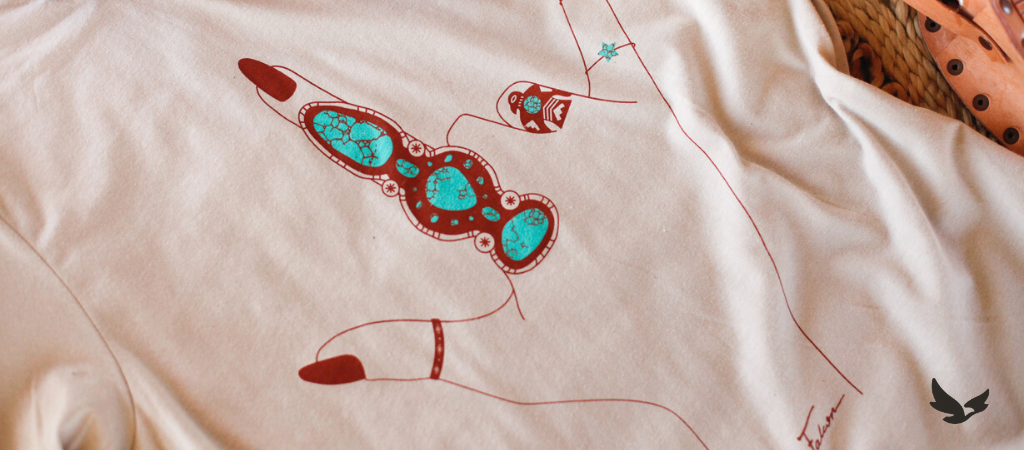
What’s now become a leather goods and t-shirt business was originally a marketing and graphic design business. Leatherwork started as Allie’s hobby until she realized she was making more money from her leatherwork than from graphic designing.
“I always joke I’m not allowed to have hobbies, because they always turn into jobs”
As Allie was prepping for the National Finals Rodeo (the biggest show she had ever participated in) she looked at her almost bare booth and thought there had to be more. Driving home one night, Allie’s husband suggested making t-shirts. Not long after Allie began developing a t-shirt line to compliment her style. Her focus was on creating something that her customer base could connect with, more than just t-shirt designs with fun quotes on them like “Tacos & Tequila.”
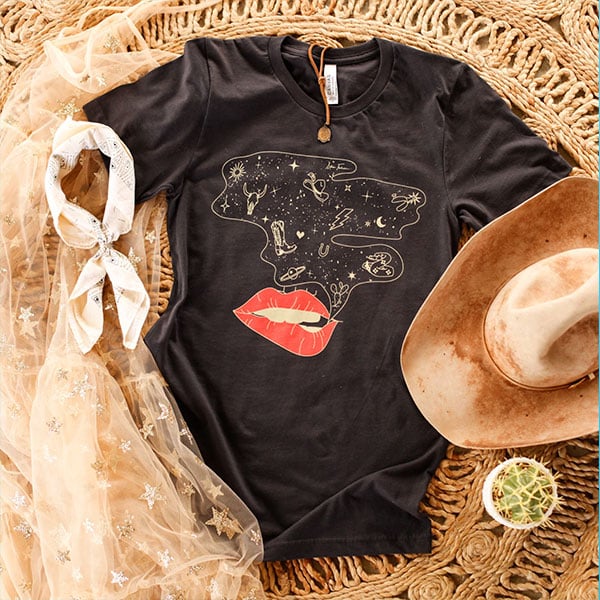
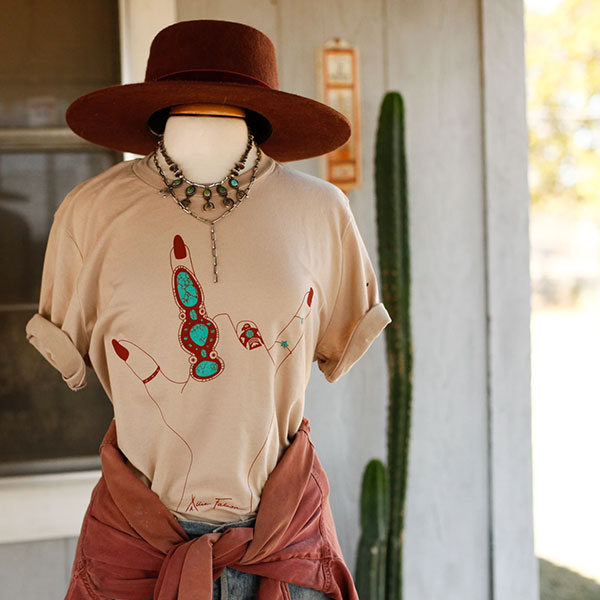
“I just didn’t see anything in the western market that was art on its own. There were quotes on everything. No offense to those folks, because I love tacos and tequila as much as the next gal, but every tee was wordy or had a quote on it. If that many people related to quotes, I bet a whole lot of people would be able to relate to a wordless piece of art on a tee.”
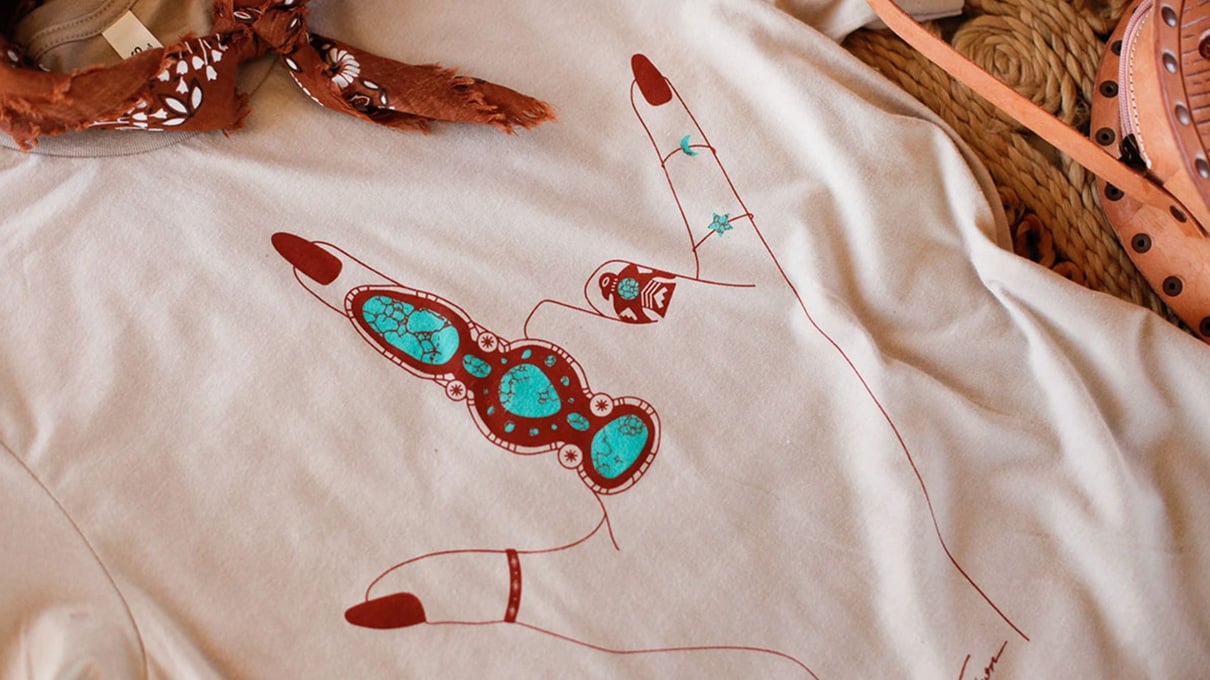
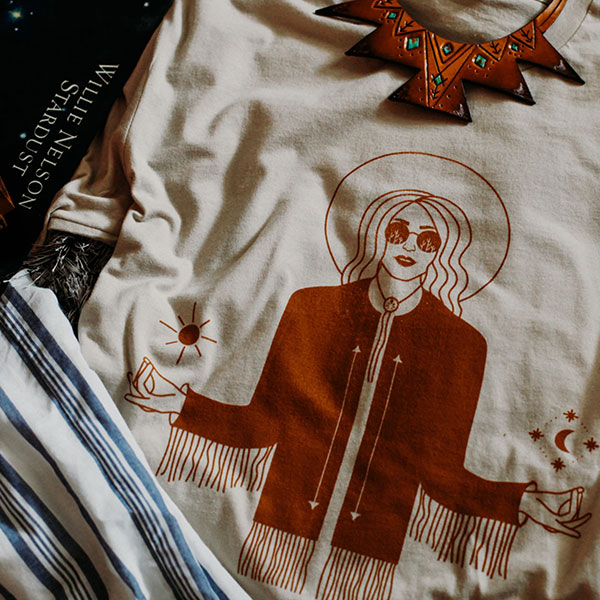
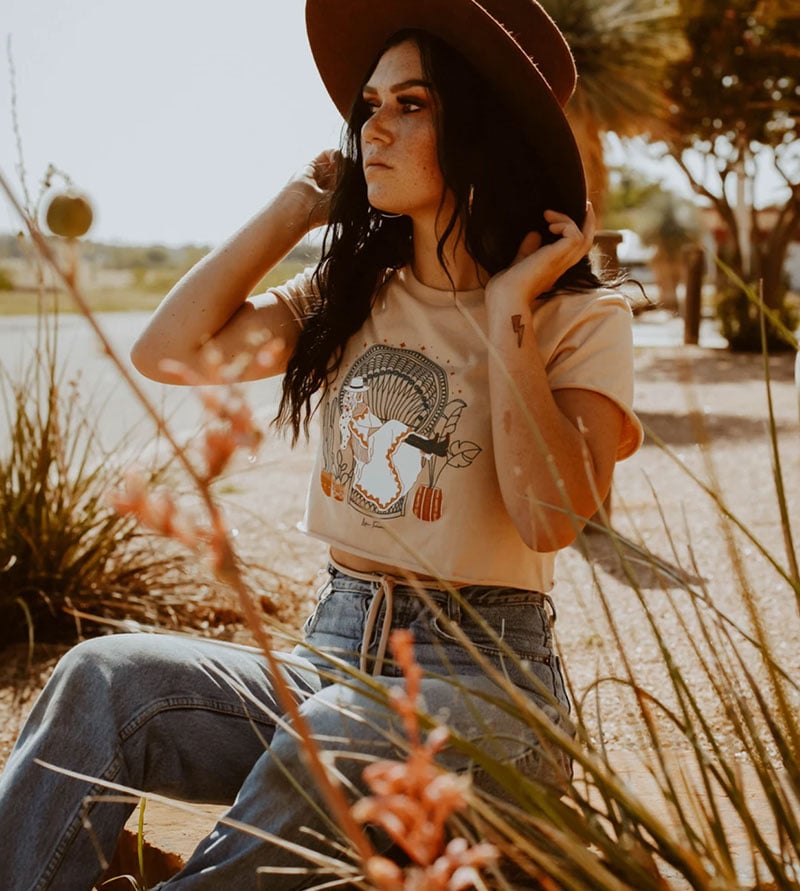
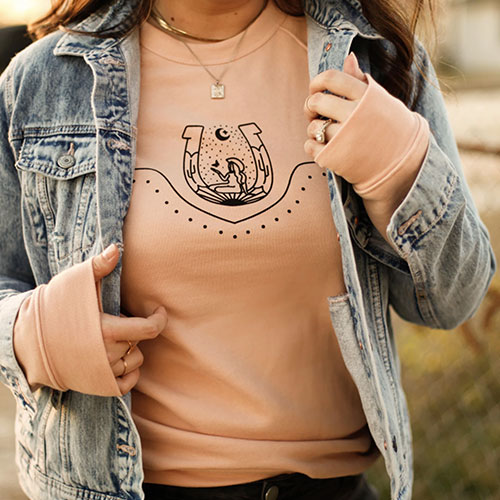
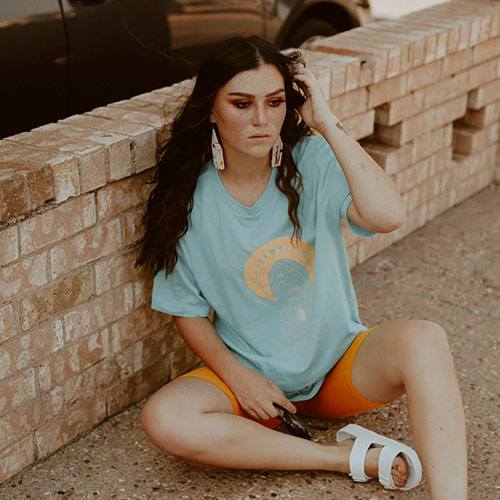
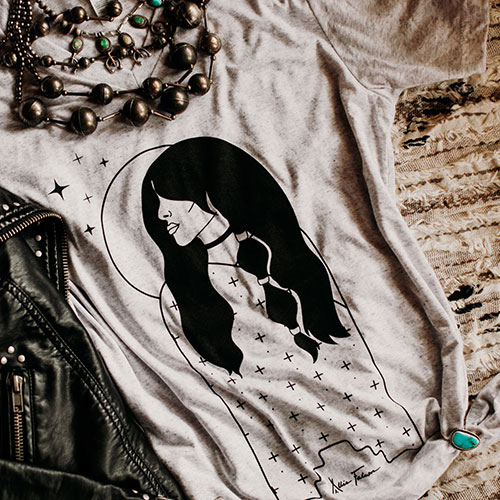
A few hours later she had the first drawings of her “Speechless Collection” complete. Allie wanted her collection to represent every western woman. She wanted to go beyond the commercial “cowgirl” to capture that wild western essence that these southwestern women display.
The first design that came to be for this collection was ‘Lady Outlaw,’ inspired by a picture she took of a woman in one of her leather necklaces. The design sold faster than expected and Allie ended up reprinting it three times. Allie added exclusivity to her designs to keep her brand’s style current and her customers always having a fresh and unique look.
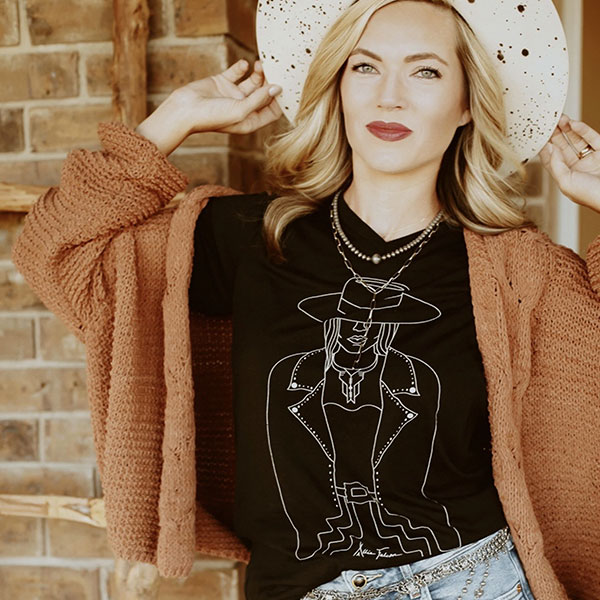
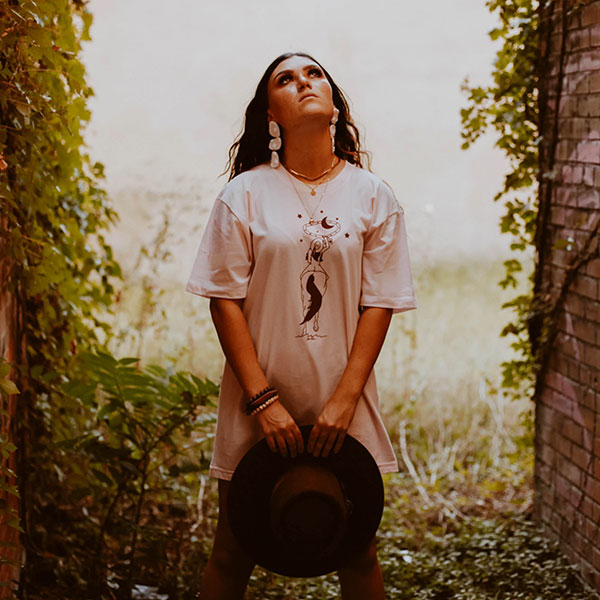
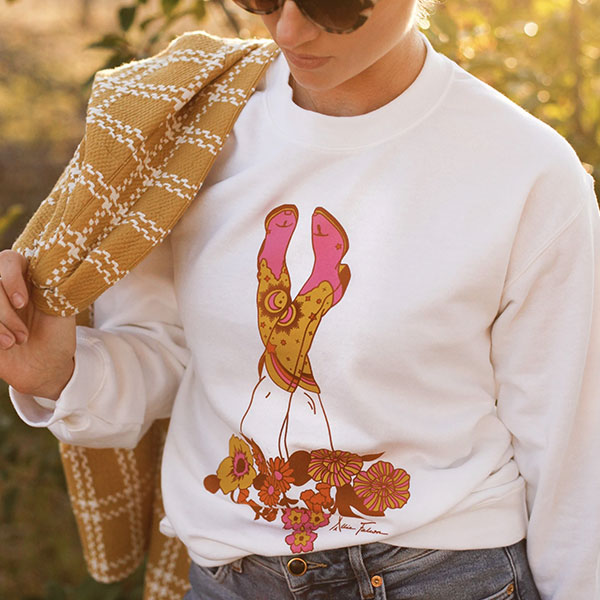
“I like to retire my designs after a while because part of the fun of fashion is dressing uniquely. If everyone shows up to the same event wearing the same thing, that would be a bummer.”
Allie’s t-shirt business stemmed from her passion for leatherwork. Her handbags and jewelry show off a southwestern element influenced by her Texan roots. Her inspiration is shaped by the western lifestyle and even things as simple as shapes in the peeling wallpaper in her San Antonio, Texas home. Allie’s designs are her essence in its purest form.
To this day Allie is at home with her ranch lifestyle. “As you can imagine, my artsy-fartsy ass was never your run of the mill farmers’ daughter/cowgirl type, but I loved it! Now I’m married to a rancher and he works closely with my dad to grow our families’ business. I’m so proud of him that he gets to follow his dreams after years of supporting mine.”
Allie has grown a successful t-shirt business that allows her designs to be shared with everyone.
“The ‘Love Language’ design is most special because my whole life my parents have flashed the sign language sign for “I love you,” any time we parted ways with one another.”
Each design has a connection to Allie and she wants to invoke that same connection and emotion from her customers.
When it comes to choosing blank garments, Allie is a Bella + Canvas fan. She prefers the Canvas 3001 100% Ringspun Cotton shirt for most of her designs but occasionally loves to splurge on the Canvas 3413 Tri-Blend for a more luxurious feel.
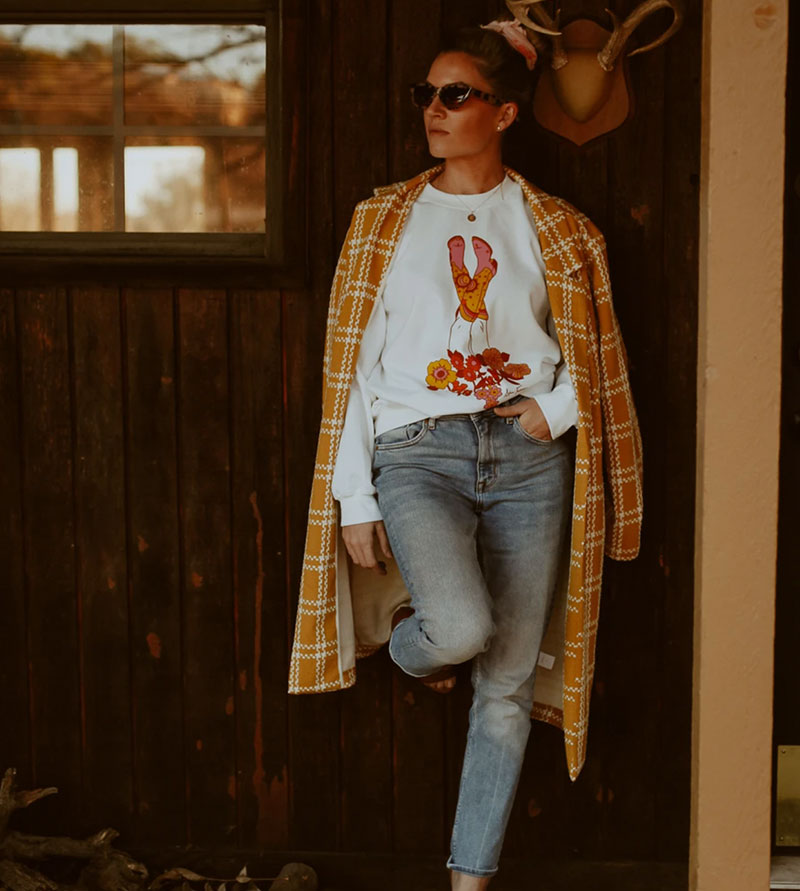
Like any small business today, social media has helped Allie build traction for her brand. Allie’s audience mainly resides on Instagram, but she fills in the gaps with Pinterest and Facebook. However, Allie doesn’t just limit her brand to social media alone. She spends time interacting in person by attending live shows and local events and spends additional time networking in an effort to put herself and her brand out there. Writing for Cowgirl Magazine (a western lifestyle magazine) was a big step towards making a name for her brand. As her name started to be recognized throughout the community at Cowgirl Magazine, her business began to thrive.
Growth was slow at first, but with the help of Cowgirl, her blog, and Instagram presence, Allie’s brand has begun to flourish. “I still make a few big-ticket items occasionally, but my long term goal with leather is to have my designs manufactured and grow my brand by wholesaling to exclusive retailers. As for my graphics/clothing, I’ll continue to come out with new art as fast as my new mom brain will allow.” Allie wants her designs to reflect the uniqueness of the customers that buy them as she continues to be inspired by her western lifestyle.
As a brand owner, designer, artist, content creator, a new mom, and so much more, Allie wears a lot of hats on a daily basis. She offers this advice to others looking to start their brand:
“Be yourself. Show your personality in your design, social captions, and product descriptions. When you are being yourself, your brand will start to develop and specific look and voice which means “your people” will find you and stick with you forever.”
And…
“Be your biggest advocate. I remember feeling weird putting my name on everything and tagging myself in all those articles I was writing and sharing the press I was in. It can feel a little like, “Hey, look what I did! See how cool I am?” But honey, ain’t no one going to do that stuff for you in the beginning! LOL!”
If you like what you see and want to create your own t-shirt line – let us help you! Click here to get started with Threadbird.

Hey, It's Threadbird, here to be your expert guide with printing, apparel, and merch. Our brand has been in the custom merch game for 12+ years. We know the ins and outs of all of your favorite products. We are here to help your brand fly high with our knowledge and expertise.
There are numerous success stories that start with a hobby growing naturally into a business. Many aspire to follow a similar path, just like this cowgirl from Texas. Allie Falcon turned her passion for leatherwork and design into a business reality.
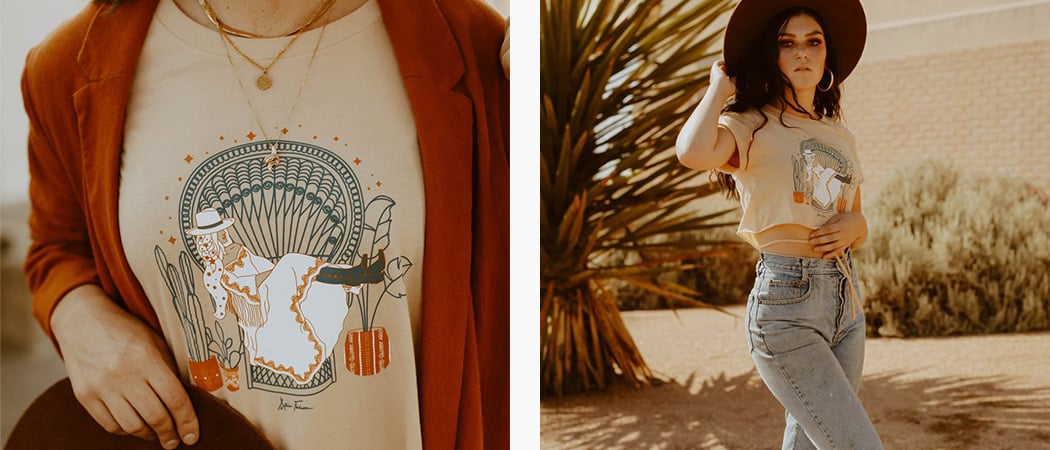
What’s now become a leather goods and t-shirt business was originally a marketing and graphic design business. Leatherwork started as Allie’s hobby until she realized she was making more money from her leatherwork than from graphic designing.
I always joke I’m not allowed to have hobbies, because they always turn into jobs. :)
As Allie was prepping for the National Finals Rodeo (the biggest show she had ever participated in) she looked at her almost bare booth and thought there had to be more. Driving home one night, Allie’s husband suggested making t-shirts. Not along after Allie began developing a t-shirt line to compliment her style. Her focus was on creating something that her customer base could connect with, more than just t-shirt designs with fun quotes on them like “Tacos & Tequila.”
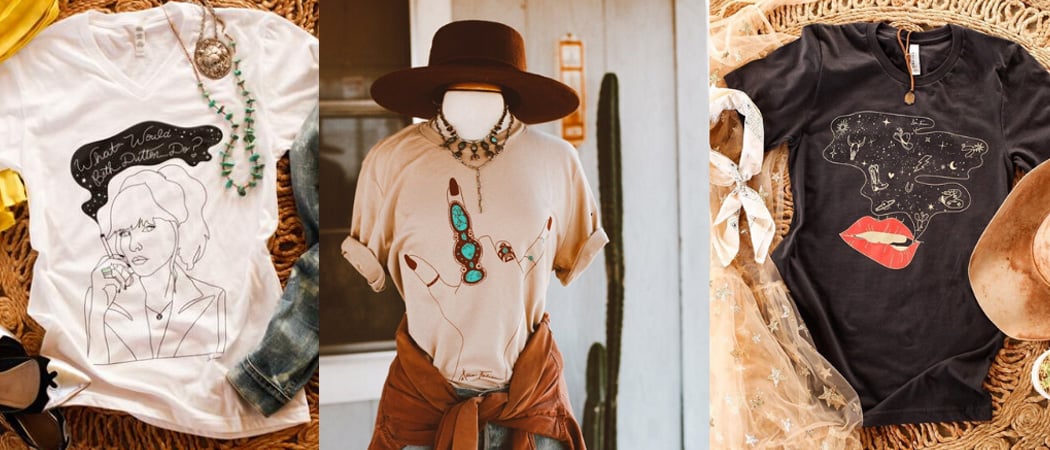
I just didn’t see anything in the western market that was art on its own. There were quotes on everything. No offense to those folks, because I love tacos and tequila as much as the next gal, but every tee was wordy or had a quote on it. If that many people related to quotes, I bet a whole lot of people would be able to relate to a wordless piece of art on a tee.
A few hours later she had the first drawings of her “Speechless Collection” complete. Allie wanted her collection to represent every western woman. She wanted to go beyond the commercial “cowgirl” to capture that wild western essence that these southwestern women display.
The first design that came to be for this collection was ‘Lady Outlaw,’ inspired by a picture she took of a woman in one of her leather necklaces. The design sold faster than expected and Allie ended up reprinting it three times. Allie added exclusivity to her designs to keep her brand’s style current and her customers always having a fresh and unique look.
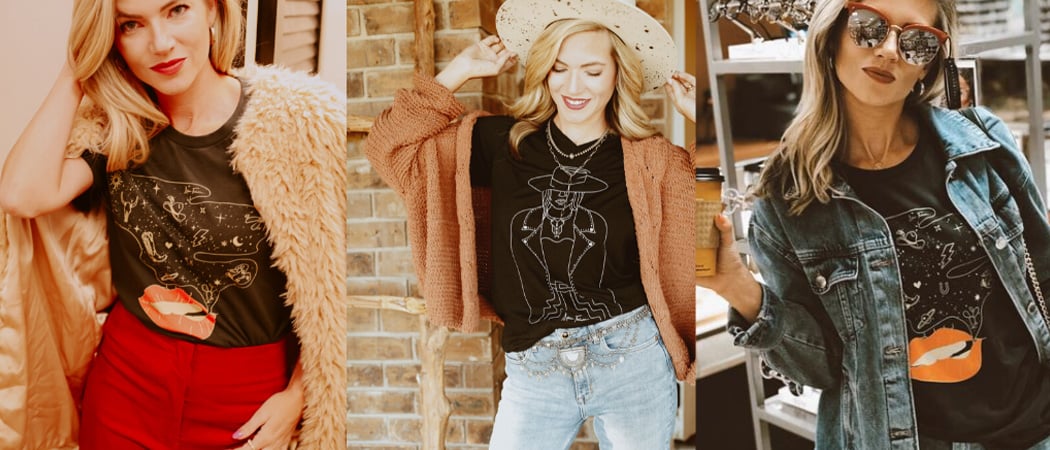
I like to retire my designs after a while because part of the fun of fashion is dressing uniquely. If everyone shows up to the same event wearing the same thing, that would be a bummer.
Allie’s t-shirt business stemmed from her passion for leatherwork. Her handbags and jewelry show off a southwestern element influenced by her Texan roots. Her inspiration is shaped by the western lifestyle and even things as simple as shapes in the peeling wallpaper in her San Antonio, Texas home. Allie’s designs are her essence in its purest form.
To this day Allie is at home with her ranch lifestyle. “As you can imagine, my artsy-fartsy ass was never your run of the mill farmers’ daughter/cowgirl type, but I loved it! Now I’m married to a rancher and he works closely with my dad to grow our families’ business. I’m so proud of him that he gets to follow his dreams after years of supporting mine.”
Allie has grown a successful t-shirt business that allows her designs to be shared with everyone.
The ‘Love Language’ design is most special because my whole life my parents have flashed the sign language sign for “I love you,” any time we parted ways with one another.
Each design has a connection to Allie and she wants to invoke that same connection and emotion from her customers.
When it comes to choosing blank garments, Allie is a Bella + Canvas fan. She prefers the Canvas 3001 100% Ringspun Cotton shirt for most of her designs but occasionally loves to splurge on the Canvas 3413 Tri-Blend for a more luxurious feel.
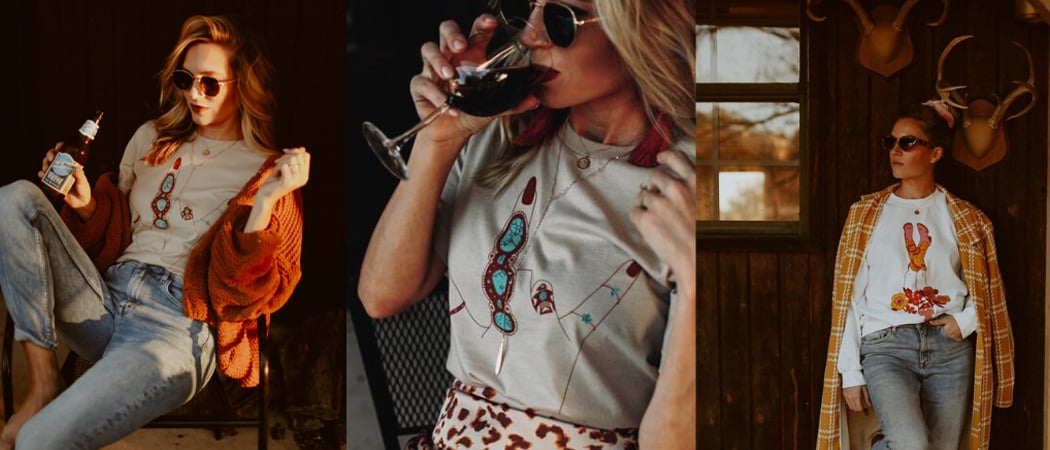
Like any small business today, social media has helped Allie build traction for her brand. Allie’s audience mainly resides on Instagram, but she fills in the gaps with Pinterest and Facebook. However, Allie doesn’t just limit her brand to social media alone. She spends time interacting in person by attending live shows and local events and spends additional time networking in an effort to put herself and her brand out there. Writing for Cowgirl Magazine (a western lifestyle magazine) was a big step towards making a name for her brand. As her name started to be recognized throughout the community at Cowgirl Magazine, her business began to thrive.
Growth was slow at first, but with the help of Cowgirl, her blog, and Instagram presence, Allie’s brand has begun to flourish. “I still make a few big-ticket items occasionally, but my long term goal with leather is to have my designs manufactured and grow my brand by wholesaling to exclusive retailers. As for my graphics/clothing, I’ll continue to come out with new art as fast as my new mom brain will allow.” Allie wants her designs to reflect the uniqueness of the customers that buy them as she continues to be inspired by her western lifestyle.
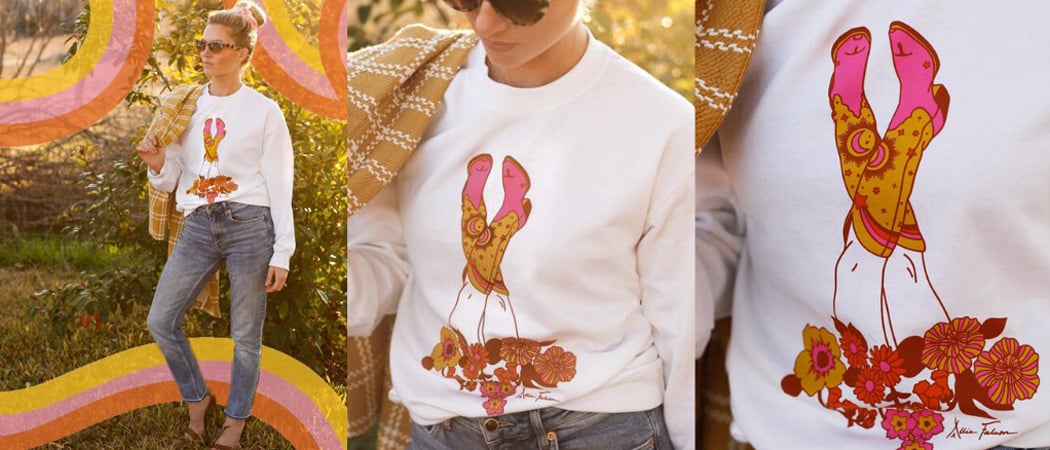
As a brand owner, designer, artist, content creator, a new mom, and so much more, Allie wears a lot of hats on a daily basis. She offers this advice to others looking to start their brand:
Be yourself. Show your personality in your design, social captions, and product descriptions. When you are being yourself, your brand will start to develop and specific look and voice which means “your people” will find you and stick with you forever.
And...
Be your biggest advocate. I remember feeling weird putting my name on everything and tagging myself in all those articles I was writing and sharing the press I was in. It can feel a little like, “Hey, look what I did! See how cool I am?” But honey, ain’t no one going to do that stuff for you in the beginning! LOL!
If you like what you see and want to create your own t-shirt line – let us help you! Click here to get started with Threadbird.
Brand Feature: Threadfast, an Eco-Friendly Brand
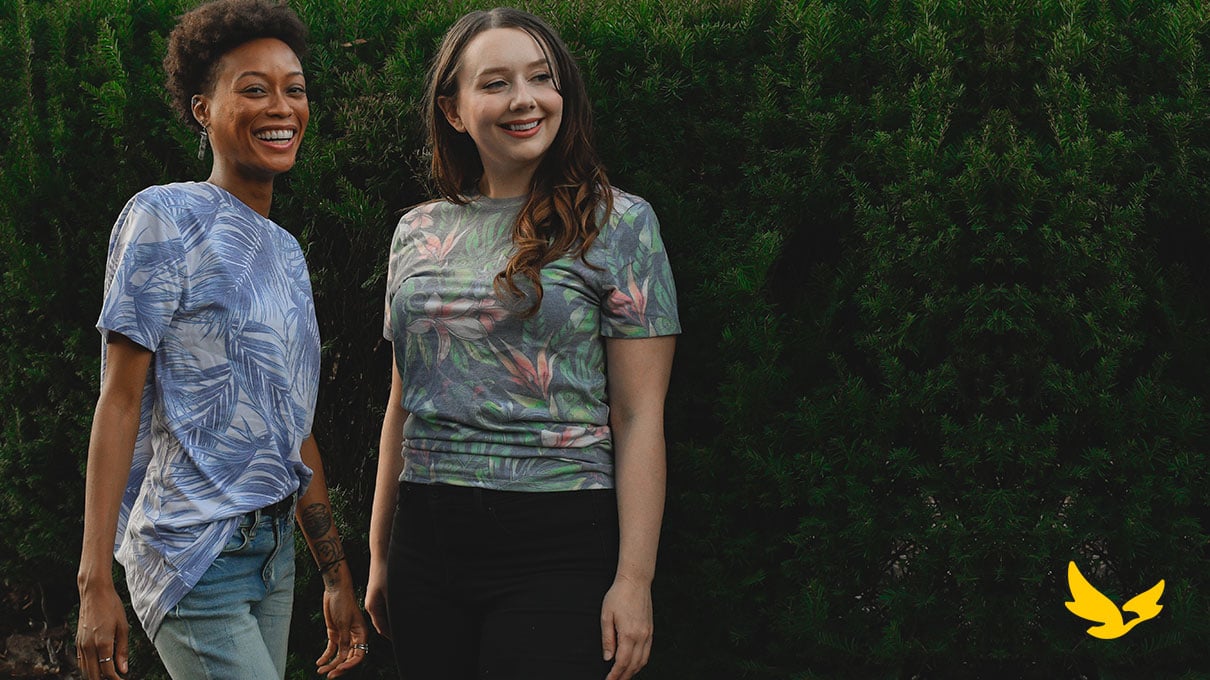
The Fashion Industry isn’t typically the first thing that comes to mind when you think about pollution. However, the apparel industry has a history of contributing to the problem through increased production.
Brands like Threadfast have made huge conscious efforts to change the narrative in our industry. Threadfast is stepping away from the typical process materials and replacing polyester with recycled water bottles and upping its standards on cotton production.
Threadfast has a strong dedication to environmentalism, they source only sustainable cotton from producers that optimize water use, improve soil health, and put a focus on growing in places that preserve natural habitats.
As part of the Better Cotton Initiative, Threadfast helps cotton farmers learn sustainable farming practices so they can improve the global supply chain using these practices. Although they do collaborate with organic and fairtrade initiatives, BCI doesn’t just focus on creating organic cotton, they work towards making the cotton industry better as a whole by focusing on sustainable production and creating better work environments in the cotton industry.
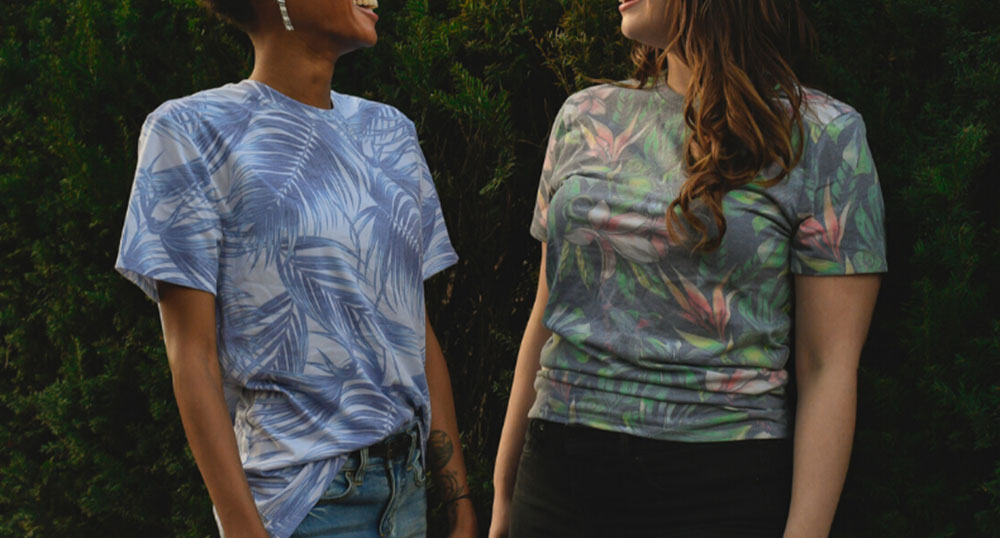
Threadfast’s heather fabrics are made using their ColorZen technology which allows fabrics to be dyed using 90% less water, 75% less energy, and 95% fewer chemicals. Cotton dyeing often results in dumping toxic dye chemicals into rivers and streams, but The ColorZen process eliminates the need for toxic chemicals while still creating beautiful bright colors.
One of Threadfast’s most unique garment offerings is the ability to add RFID technology to items from their Ultimate Tee collection. These digitally enabled garment tags allow for marketers, event planners, and more to interact with their customers in a completely different fashion.
Here are a few of our other favorite Threadfast styles:
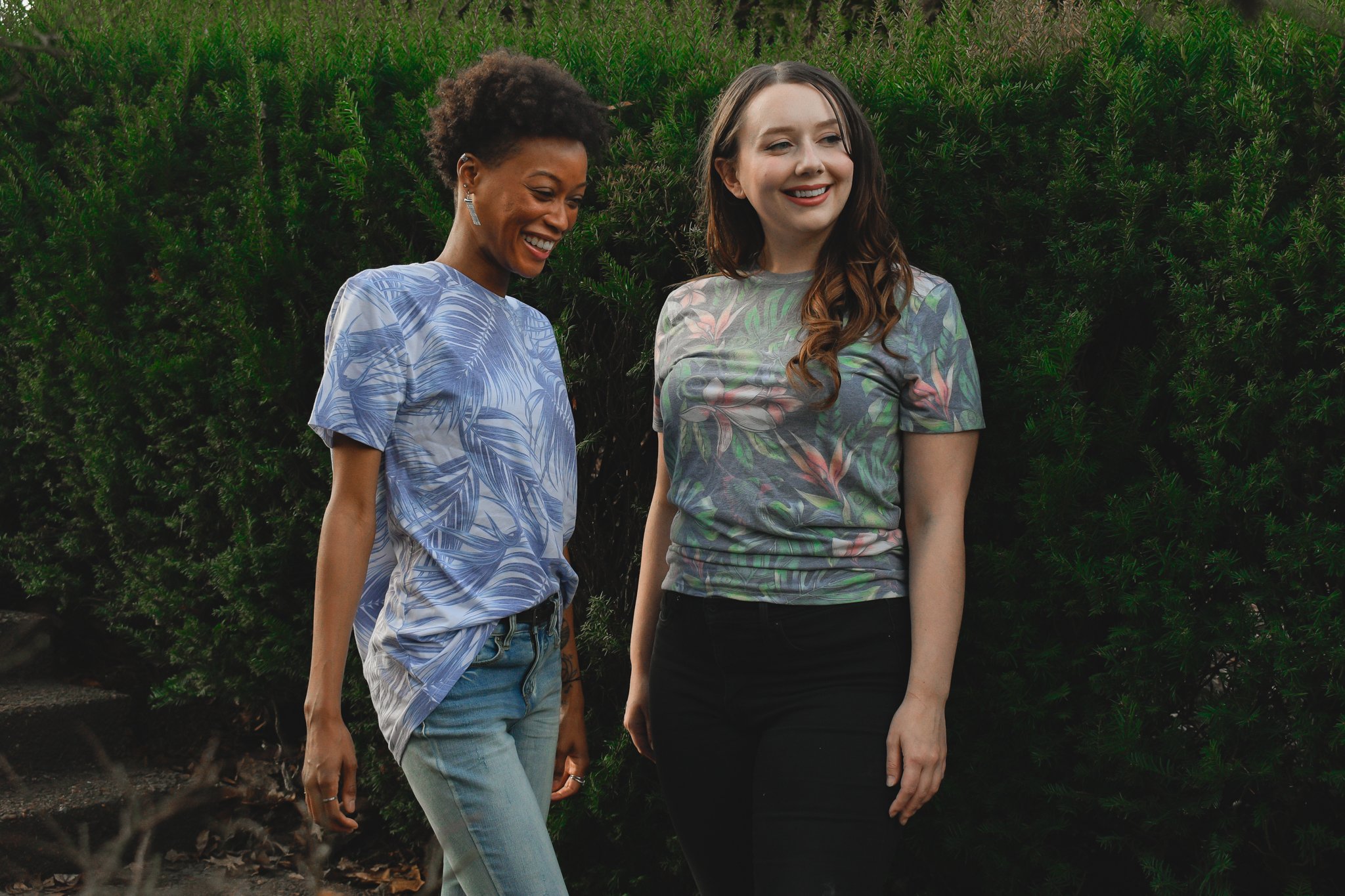
100A Ultimate Short-Sleeve Unisex T-Shirt
This classic crew cut comes in a 60% cotton / 40% polyester blend. With an optimum weight of 4.8 oz, this t-shirt is 15% heavier than most 60/40 blend t-shirts. A distinct feature that sets these shirts apart is the patterns. This shirt comes in 18 colors and three pattern designs: “Tropical Jungle”, “Chameleon”, and “Palm Leaves".
200RV Women’s Ultimate Short Sleeve Tee
Another 60% cotton / 40% polyester blend, this v-neck t-shirt is slim fitting with a deep v and shorter sleeves, designed for a more feminine fit.
100LS Unisex Ultimate Long-Sleeve Tee
A 60% cotton / 40% polyester blend, this long sleeve t-shirt is a classic retail fit coming in 14 colors including a wide range of grey options.
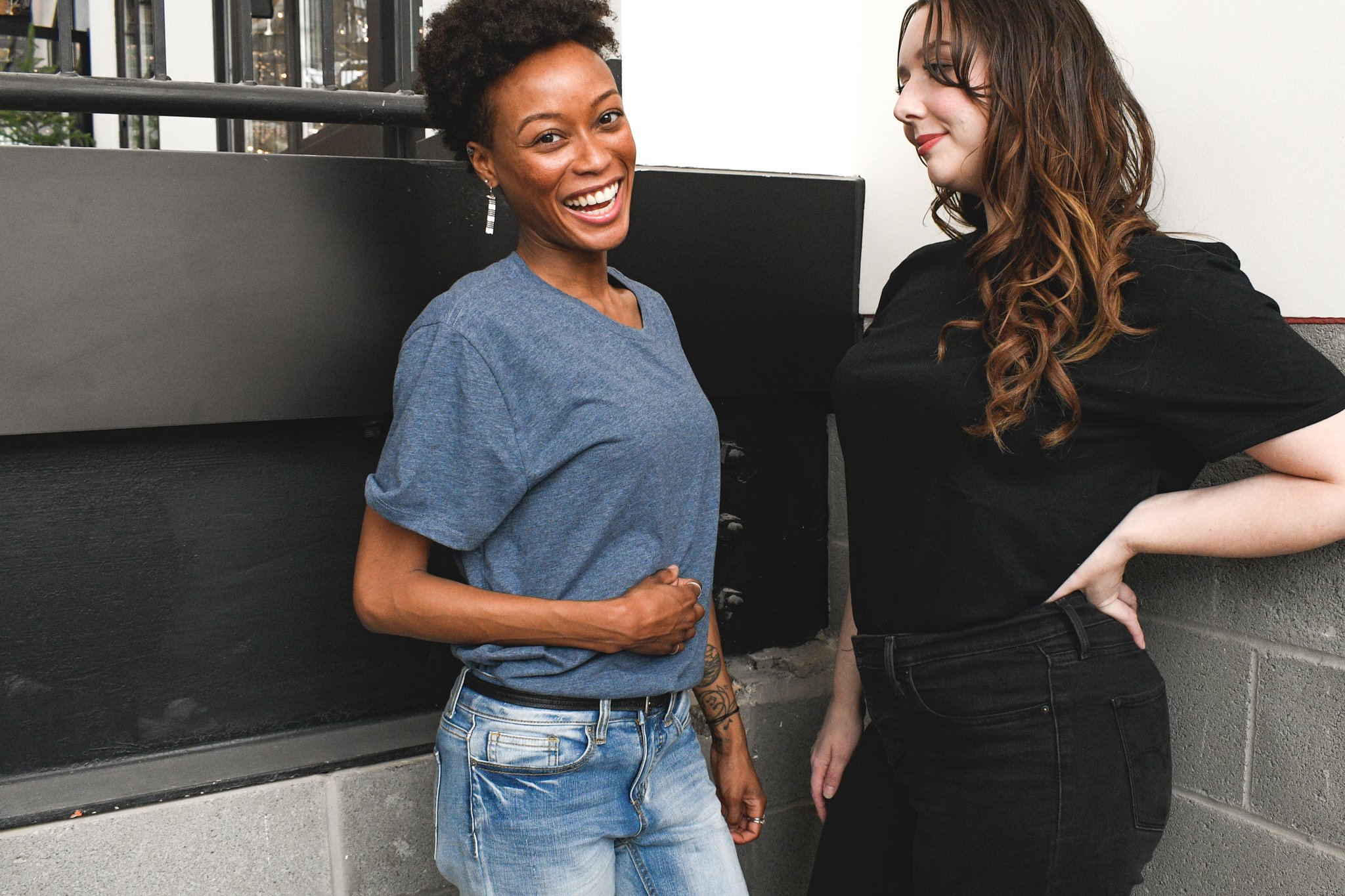
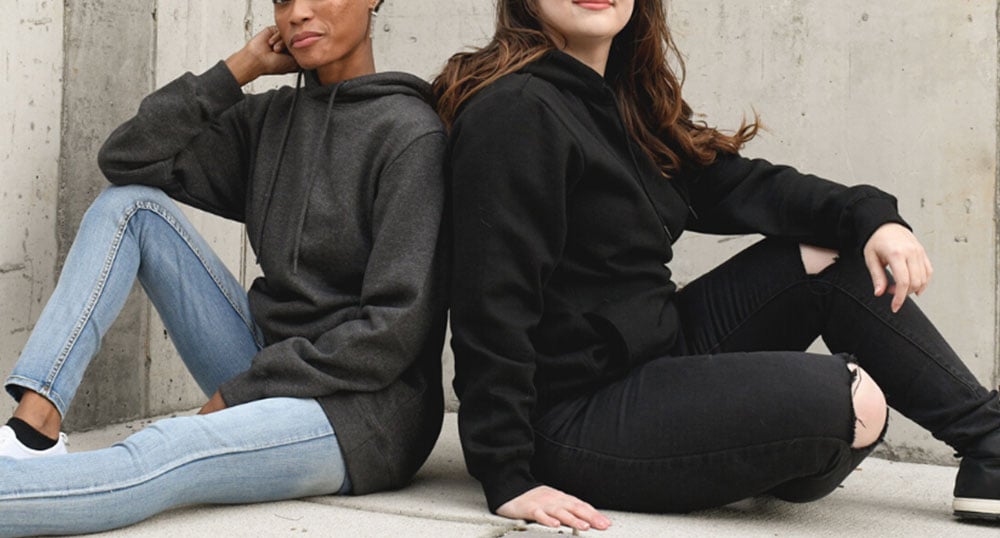
This crew-cut fleece features recycled polyester making it a sustainable sweatshirt option. Featuring ribbing around the cuffs, hem, and neck, it’s structured while still being wearable.
The Ultimate Fleece Hoodie has a super unique pocket setup. Instead of having a traditional kangaroo pocket, this hoodie features two side slit pockets. The pocket placement also allows for a larger imprint area towards the bottom of the sweatshirt. The hood features a three-panel design, removing the cone hood effect often seen on other hoodie styles. These hoodies also feature dyed-to-match eyelets, grommets, and drawstrings on all colorways for a cohesive look.
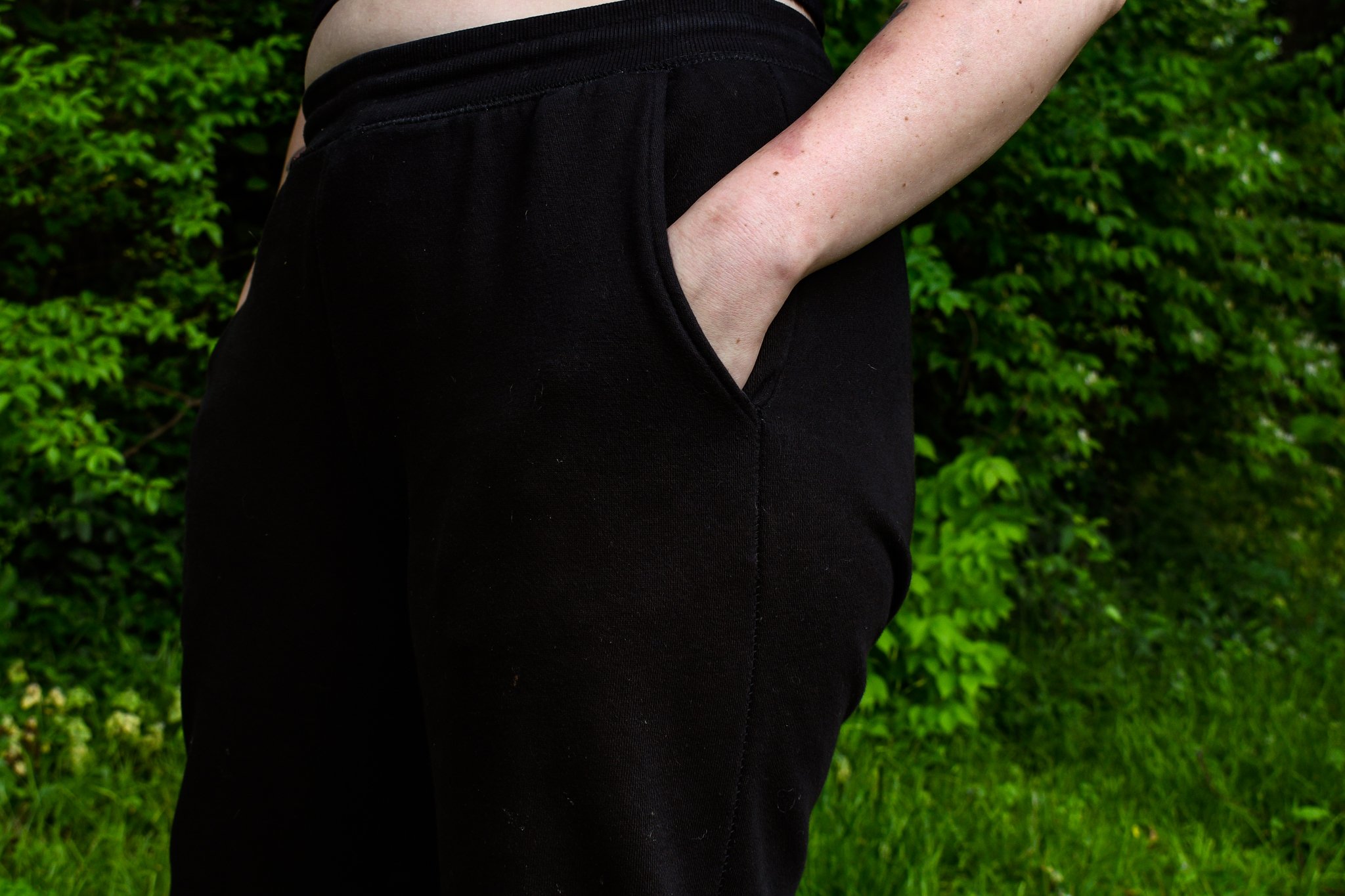
Pants should do more than just cover your legs. These fleece joggers are incredibly comfortable, soft, and extra long. These joggers feature slant pockets, a hidden drawcord on the inside for a more secure fit, with zippers on the bottom cuff.
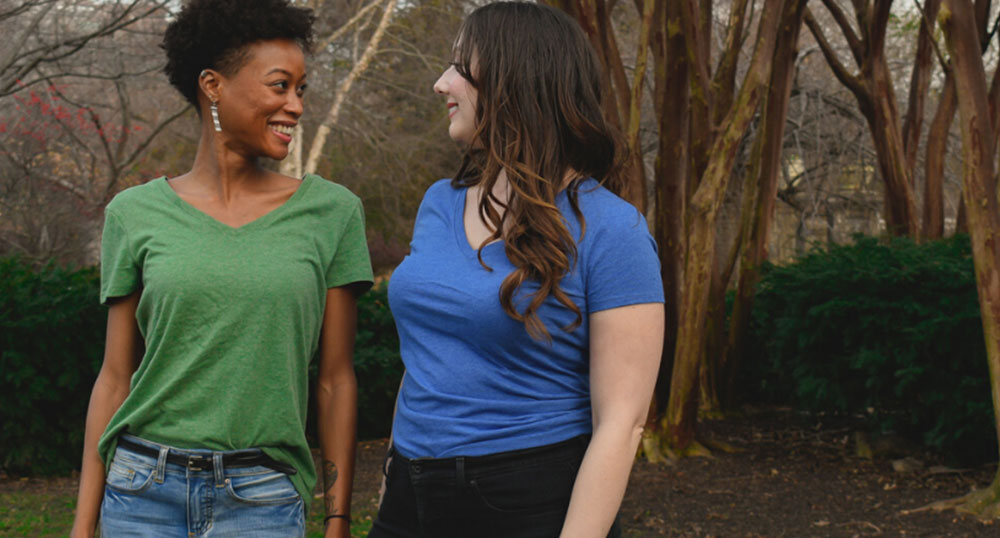
We are huge fans of brands making changes to our industry and Threadfasts dedication to being eco-conscious as well as fashion-forward makes their garments a great match for anyone looking to make their brand more eco-friendly without sacrificing a retail look.
Hey, It's Threadbird, here to be your expert guide with printing, apparel, and merch. Our brand has been in the custom merch game for 12+ years. We know the ins and outs of all of your favorite products. We are here to help your brand fly high with our knowledge and expertise.
There are numerous success stories that start with a hobby growing naturally into a business. Many aspire to follow a similar path, just like this cowgirl from Texas. Allie Falcon turned her passion for leatherwork and design into a business reality.
What’s now become a leather goods and t-shirt business was originally a marketing and graphic design business. Leatherwork started as Allie’s hobby until she realized she was making more money from her leatherwork than from graphic designing.
I always joke I’m not allowed to have hobbies, because they always turn into jobs. :)
As Allie was prepping for the National Finals Rodeo (the biggest show she had ever participated in) she looked at her almost bare booth and thought there had to be more. Driving home one night, Allie’s husband suggested making t-shirts. Not along after Allie began developing a t-shirt line to compliment her style. Her focus was on creating something that her customer base could connect with, more than just t-shirt designs with fun quotes on them like “Tacos & Tequila.”
I just didn’t see anything in the western market that was art on its own. There were quotes on everything. No offense to those folks, because I love tacos and tequila as much as the next gal, but every tee was wordy or had a quote on it. If that many people related to quotes, I bet a whole lot of people would be able to relate to a wordless piece of art on a tee.
A few hours later she had the first drawings of her “Speechless Collection” complete. Allie wanted her collection to represent every western woman. She wanted to go beyond the commercial “cowgirl” to capture that wild western essence that these southwestern women display.
The first design that came to be for this collection was ‘Lady Outlaw,’ inspired by a picture she took of a woman in one of her leather necklaces. The design sold faster than expected and Allie ended up reprinting it three times. Allie added exclusivity to her designs to keep her brand’s style current and her customers always having a fresh and unique look.
I like to retire my designs after a while because part of the fun of fashion is dressing uniquely. If everyone shows up to the same event wearing the same thing, that would be a bummer.
Allie’s t-shirt business stemmed from her passion for leatherwork. Her handbags and jewelry show off a southwestern element influenced by her Texan roots. Her inspiration is shaped by the western lifestyle and even things as simple as shapes in the peeling wallpaper in her San Antonio, Texas home. Allie’s designs are her essence in its purest form.
To this day Allie is at home with her ranch lifestyle. “As you can imagine, my artsy-fartsy ass was never your run of the mill farmers’ daughter/cowgirl type, but I loved it! Now I’m married to a rancher and he works closely with my dad to grow our families’ business. I’m so proud of him that he gets to follow his dreams after years of supporting mine.”
Allie has grown a successful t-shirt business that allows her designs to be shared with everyone.
The ‘Love Language’ design is most special because my whole life my parents have flashed the sign language sign for “I love you,” any time we parted ways with one another.
Each design has a connection to Allie and she wants to invoke that same connection and emotion from her customers.
When it comes to choosing blank garments, Allie is a Bella + Canvas fan. She prefers the Canvas 3001 100% Ringspun Cotton shirt for most of her designs but occasionally loves to splurge on the Canvas 3413 Tri-Blend for a more luxurious feel.
Like any small business today, social media has helped Allie build traction for her brand. Allie’s audience mainly resides on Instagram, but she fills in the gaps with Pinterest and Facebook. However, Allie doesn’t just limit her brand to social media alone. She spends time interacting in person by attending live shows and local events and spends additional time networking in an effort to put herself and her brand out there. Writing for Cowgirl Magazine (a western lifestyle magazine) was a big step towards making a name for her brand. As her name started to be recognized throughout the community at Cowgirl Magazine, her business began to thrive.
Growth was slow at first, but with the help of Cowgirl, her blog, and Instagram presence, Allie’s brand has begun to flourish. “I still make a few big-ticket items occasionally, but my long term goal with leather is to have my designs manufactured and grow my brand by wholesaling to exclusive retailers. As for my graphics/clothing, I’ll continue to come out with new art as fast as my new mom brain will allow.” Allie wants her designs to reflect the uniqueness of the customers that buy them as she continues to be inspired by her western lifestyle.
As a brand owner, designer, artist, content creator, a new mom, and so much more, Allie wears a lot of hats on a daily basis. She offers this advice to others looking to start their brand:
Be yourself. Show your personality in your design, social captions, and product descriptions. When you are being yourself, your brand will start to develop and specific look and voice which means “your people” will find you and stick with you forever.
And...
Be your biggest advocate. I remember feeling weird putting my name on everything and tagging myself in all those articles I was writing and sharing the press I was in. It can feel a little like, “Hey, look what I did! See how cool I am?” But honey, ain’t no one going to do that stuff for you in the beginning! LOL!
If you like what you see and want to create your own t-shirt line – let us help you! Click here to get started with Threadbird.